How to render fat into tallow and lard
Last Updated on March 2, 2026 by Annie Bernauer
I first learned how to render fat into tallow and lard years ago and was amazed at how easy it is! Some people discard the fat when butchering animals. Learning how to render fat into tallow and lard is a great way to use all parts of the animal. I’m going to share three easy ways to render fat into tallow and lard.
Tallow and lard are made by melting down and filtering fat from animals. The most common types of fat to render are beef (tallow) and pork (lard). When helping friends butcher their sheep, I took home a big bag of fat that I rendered to make some wonderful homemade sheep tallow soap. I’ve even rendered wild game fat from deer and elk into tallow that also makes a wonderful homemade soap.

Where to find fat to render into tallow and lard
The easiest way to acquire fat to render is if you are doing your own butchering or know people who do their own butchering. While dressing down the animal, collect all the fat from various parts of the animal. Butchering day can be quite busy so I put all the fat in bags and freeze it until another day when I have more time to render it.
Butcher shops sell bags of fat for people to render. It is typically sold in bulk bags by the pound. You likely won’t know how the animal was raised (i.e. non GMO, grass fed or organic practices) but it will likely be local.
The meat counter in the grocery store often has bulk fat available for purchase. Years ago I wanted to make some homemade suet cakes to feed the wild birds and found bulk packages of beef fat at the grocery store meat counter.
Small farms that raise beef, pork and sheep are another great source for finding fat to render. We have a local organic farm store in our community that sells bulk packages of fat. This is where we purchased our recent bulk bag of beef fat for rendering. This is my favorite option for sourcing fat to render since I know that the animals were raised with organic practices and grass fed. Therefore the products we make with the tallow are going to be cleaner, healthier and more nutritious.
How to render tallow and lard in the slow cooker
I first learned how to render fat into tallow and lard using my crock pot/slow cooker. This is my favorite method since I can put the fat in the slow cooker, put the lid on, let it heat up and melt all day while I go about my day on the homestead.
The other nice thing about using a slow cooker to render fat is that it can be put outside when rendering fats if the smell bothers you. I personally don’t mind the smell of rendering beef tallow or lard but venison can be a bit more gamey. When rendering venison fat into tallow, I put the slow cooker outside on a table on the back porch.
Supplies needed to render tallow and lard:
Animal fat from beef, pork, sheep, wild game
Slow cooker
Sharp chopping knife and cutting board OR Food processor OR meat grinder
Fine mesh strainer (I have a set like this and use them for so many things in my kitchen!)
Fine Cheesecloth (It’s important to use a very fine cloth like this one to ensure all the meat bits are filtered out and don’t cause the final product to go rancid)
Canning funnel (optional but makes the filtering process much easier and cleaner!)
Storage jars or containers (I use wide mouth freezer safe canning jars or repurposed plastic sour cream/yogurt containers)
Directions for rendering tallow and lard:
1. Use a sharp knife to chop the fat into tiny pieces. If you have a grinder or food processor, use that to chop it up. This step is an important one you shouldn’t skimp on unless you want to be rendering fat for days lol! The smaller the pieces of fat, the faster it will melt down. The fat is much easier to chop when it is cold instead of room temperature.
2. Place the chopped pieces of fat into the slow cooker. Add about 1/2 cup water to help prevent burning until it starts to melt. This water will be cooked off in a later step.

3. Place the lid on the slow cooker and turn it on low to start. Every slow cooker is different and heat levels vary so monitor and adjust the heat as needed. My biggest slow cooker is older and the low setting just isn’t hot enough to melt the fat well. For my older model slow cooker, I turn the heat up to high for a little while until the fat starts melting. Then I turn it back down to low to finish.
It’s important to not heat the fat too high and burn it or cause a fire. The fat should be cooked in the 220-250 degree F temperature range. Over 275 degrees F will burn the fat.
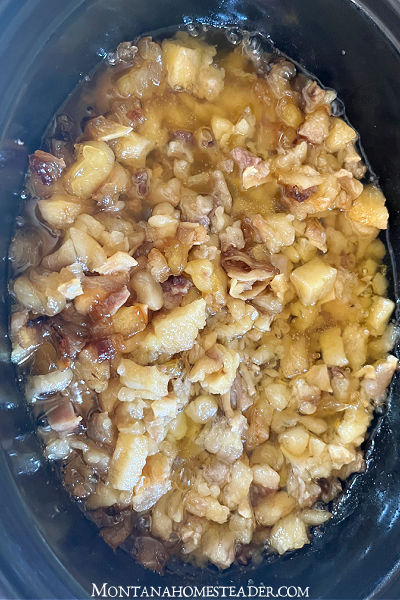
4 .About an hour or two before the fat is done melting, take the lid off to let the water moisture cook off from the fat. Water can cause the finished tallow and lard to turn rancid so this is an important step.
5. The heating process is done when it looks like all the fat bits have melted and there are only meat or cartilage bits floating in the melted fat. Turn the heat off the slow cooker and prepare for the filtering process.
6. Filter the melted fat into jars or containers by pouring it through a fine mesh strainer lined with fine cheesecloth. This will filter out any bits of meat and cartilage so you are left with pure fat. I place the cloth lined strainer in my canning funnel to help hold it in place and contain any liquid fat that may seep through the sides of the strainer.
Since the fat is still very hot, be very careful when pouring. I use a glass measuring cup with a handle to scoop out of the slow cooker and pour into the cheesecloth lined strainer. When the strainer is full of meat bits, empty it out (I feed it to our chickens and they absolutely love this delicious treat!). Continue the process until all the fat has been filtered.
7. Let the liquid fat cool. Put lids on the jars or containers for storage. If properly rendered, I’ve read that tallow and lard can safely be stored at room temperature for six months to a year if stored away from light, heat and moisture. It can also be stored in the refrigerator or frozen. I usually do large batches when rendering fat so freeze the extra tallow and lard to use in the future.
How to render tallow and lard on the stove top
To render fat into tallow and lard on the stovetop, follow step one above for chopping the fat. Instead of placing the fat into a slow cooker, place the chopped fat into a large stock pot or cast iron dutch oven with 1/2 cup water.
Heat the fat on low/medium on the stovetop. Monitor the heat to ensure it does not get too hot. Ideal temperature is 220-250 degrees F. Fat that is heated too high past 275 degrees F can burn.
When the fat is all melted, follow steps 6 and 7 above to filter and properly store it.
How to render fat into tallow and lard over a camp fire
Long before we had electricity, folks would render fat into tallow and lard over an open fire. This is not as common of a method in our modern society with electricity. We rendered fat over an open fire in our forest school to teach the kids how to render fat and use it to make pemmican.
When rendering fat over an open fire, you will need to use large cast iron dutch ovens with lids. Place the chopped fat into the dutch ovens with 1/2 cup water per pot and put the lid on. Again it is important to heat the fat so it melts but not so hot it burns or catches fire.
You can place coals under and on top of the dutch ovens like I described in our post on how to bake outdoors in dutch ovens. The cooking temperature range you are aiming for is 220-250 degrees F so this would equate to 22-25 pieces of charcoal split evenly between the top and bottom of the dutch ovens.
If you have a cooking grate that fits on top of the fire pit, you can use this to sit the dutch ovens on top to heat so you can adjust placement and heat level accordingly.
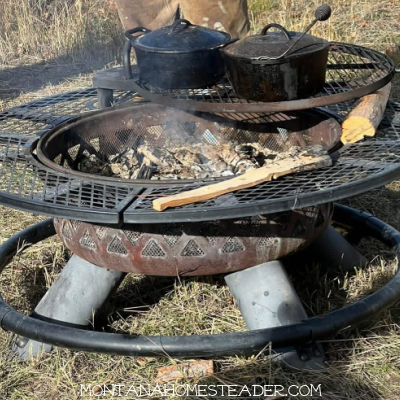
Rendering fat into tallow and lard over an open fire requires consistent monitoring to ensure the dutch ovens do not get too hot. There’s no dial to turn the heat up or down or tell you how hot they are getting. Instead you will have to look inside the dutch ovens to observe how hot the fat is. You can also use a metal heat safe thermometer like this to test the temperature and ensure it’s in the 220-250 degree F range.
Once all the fat is melted, follow steps 6-7 from the section above on how to render fat in a slow cooker.
Clean up after rendering fat into tallow and lard
When cleaning up after rendering tallow and lard, be careful not to wash any of the fat down the drain or it could cause some clogged drains as it solidifies.
My preferred clean up method is to wipe everything down with dry paper towels to remove as much of the fat and residue as possible. Then I wash everything with hot soapy water. Any bits of meat leftover or scraped out of the pan are fed to our chickens for a delicious treat so nothing goes to waste!
Uses for rendered tallow and lard
Many folks have started using rendered tallow and lard in cooking as a way to have more natural fats in their diet. This is how my great grandmothers cooked several generations ago, often sourcing the fats from their own farm animals.
I also like to use rendered fat for making natural body care products. I use rendered lamb/sheep fat and rendered venison fat for making soap. Once the fat is rendered and strained, there are no noticeable odors that would make the soap smell gamey.
One year I experimented with collecting all of our bacon fat, strained it and made a batch of bacon fat soap. Now THAT soap did have a slight bacon scent when you used it!
Using tallow in natural body care products has become popular the last few years. Tallow is known for being moisturizing for the skin and can be used for making lotion, body butter, lip balm and soap. We’ve also used tallow to make homemade candles. The possibilities are endless! For more ideas on uses, check out this article from a fellow homesteader on 15 uses for tallow.